

In industrial vacuum systems, especially those using dry vacuum pumps, exhaust noise is a common and often underestimated issue. During operation, high-speed airflow discharged from the exhaust port generates significant aerodynamic noise. Without proper noise control, this can negatively impact the working environment, interfere with nearby equipment, and pose long-term health risks to operators exposed to excessive noise levels. Therefore, selecting an appropriate vacuum pump silencer is an essential step in system design and optimization.
Vacuum pump silencers are generally classified into three main types based on their noise reduction principles: resistive silencers, reactive silencers, and combination (impedance composite) silencers. Understanding the characteristics of each type helps users make a more effective and economical choice.

Resistive Vacuum Pump Silencers
Resistive silencers reduce noise primarily through sound absorption. They are constructed with porous sound-absorbing materials, such as acoustic cotton or fibrous media. When sound waves pass through these materials, acoustic energy is absorbed and converted into heat, resulting in reduced noise emission.
This type of silencer is particularly effective at attenuating mid- and high-frequency noise, which is commonly produced by airflow turbulence at the exhaust outlet. Resistive silencers feature a simple structure, relatively low cost, and compact design, making them suitable for applications with limited installation space.
However, their effectiveness against low-frequency noise is limited, and the internal sound-absorbing materials may become contaminated by oil mist, dust, or moisture over time. Regular inspection and replacement of the absorbing media are therefore necessary to maintain stable performance.
Reactive Vacuum Pump Silencers
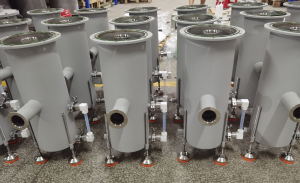
Reactive silencers operate on a different principle. Instead of absorbing sound, they reduce noise by altering the acoustic impedance of the exhaust path. This is achieved through structural elements such as expansion chambers, resonance cavities, or baffle systems, which cause sound waves to reflect and interfere with each other, leading to partial cancellation.
Reactive silencers are especially effective in suppressing low-frequency noise, which is often more difficult to control using absorbent materials alone. Since they do not rely on porous media, they are generally more resistant to oil vapor and particulate contamination, making them suitable for harsh industrial environments and continuous-duty applications.
The main limitation of reactive silencers is their relatively large size and weaker attenuation performance in the mid- to high-frequency range. As a result, they are often used where low-frequency noise is the primary concern or combined with other silencing methods.

Combination Silencers and Selection Guidelines
Combination silencers integrate both resistive and reactive elements into a single structure, allowing them to provide effective noise reduction across a wider frequency range. By combining sound absorption and wave interference, these silencers offer balanced performance for complex noise spectra typically found in industrial vacuum pump systems.
When selecting a vacuum pump silencer, users should consider several key factors: the dominant noise frequency, installation space, operating conditions, and maintenance requirements. For applications with predominantly high-frequency noise, a resistive silencer may be sufficient. For low-frequency-dominated noise, a reactive silencer is more appropriate. In environments with strict noise regulations or mixed-frequency noise, a combination silencer is often the optimal solution.
Our vacuum pump silencers are designed to achieve noise reduction levels of approximately 30–50 dB, while maintaining a simple structure that allows for easy maintenance, such as periodic replacement of sound-absorbing materials. Proper silencer selection not only improves workplace safety and comfort but also enhances overall system reliability and operational efficiency.

Post time: Dec-29-2025


