

Recently, LVGE has received feedback from numerous clients reporting that the exhaust filters on their vacuum pumps have a very short service life, often requiring frequent replacement. Even some expensive, original imported filter elements fail to last more than a few months. Over time, this constant replacement not only increases consumable costs but also consumes significant maintenance time, causing considerable frustration for many businesses. Is this a quality issue with the exhaust filters themselves, or is there another underlying reason? Let's use a real case study to delve into the root of the problem.
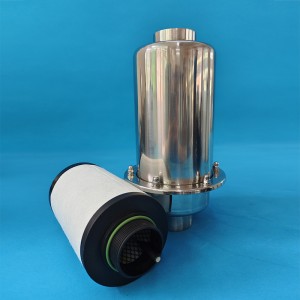
Case Review: The Original Exhaust Filter That Failed in One Month
A client from the glass coating industry sent their used vacuum pump exhaust filter to LVGE for analysis. According to the client, they had tried exhaust filters from several different brands, all with unsatisfactory results. Even an expensive, original imported filter element, after being installed, caused the vacuum pump exhaust port to emit visible smoke within just one month, necessitating another replacement.
Upon receiving the sample, we conducted a detailed inspection. After opening the filter element, we found a thick layer of sludge-like substance accumulated inside. This viscous material had completely clogged the pores of the filter media. This phenomenon indicated that the exhaust filter had not failed due to its own quality, but was instead "choked" by external contaminants.

Diagnosis: Protect the Exhaust Port but Ignore the Inlet Port of Vacuum Pump
Further communication with the client revealed the status of their vacuum pump inlet filtration. The result confirmed our suspicion: the vacuum pump had no inlet filter installed at all. In the glass coating process, the vacuum pump needs to extract gases containing significant amounts of dust, particles, and process residues. Due to the lack of effective interception at the inlet, these contaminants entered the pump chamber directly.
Once inside, the dust mixed with the pump oil under conditions of high temperature and high-speed agitation, gradually forming viscous sludge. This sludge then traveled with the exhaust flow into the exhaust filter, rapidly clogging the filter media pores. This led to increased exhaust resistance and a sharp drop in filtration efficiency. Ultimately, unfiltered oil mist was discharged from the exhaust port, resulting in the visible "smoking." Concurrently, the clogged exhaust filter lost its ability to recover pump oil, leading to a significant increase in oil consumption.
Solution: Collaborative Protection – Inlet Filter and Exhaust Filter Must Work Together
This case clearly reveals a truth often overlooked: The lifespan of an exhaust filter largely depends on the effectiveness of the inlet-side protection. Focusing only on exhaust filtration while neglecting contaminant interception at the inlet is like "guarding the back door but leaving the front gate unguarded." No matter how good the exhaust filter is, it cannot withstand the continuous assault of incoming pollutants.
To make exhaust filters truly durable, the key is to select the appropriate inlet filter based on the specific operating conditions:
1. Analyze the Gas Composition: First, determine what contaminants are present in the pumped gas—are they dust particles, liquid mist (water or oil), or corrosive chemical gases?
2. Targeted Selection:
- Primarily Dust: Configure a high-efficiency particulate filter to block solid particles.
- Primarily Moisture or Oil Mist: Configure a coalescing filter or separator to remove liquid components.
- Chemical Gases: Select filters made from corrosion-resistant materials, possibly incorporating adsorption devices if necessary.
3. Regular Inspection and Maintenance: Inlet filters themselves require periodic replacement or cleaning to ensure they remain effective.
When contaminants are effectively intercepted at the inlet, the amount of pollutants entering the pump chamber and reaching the exhaust filter is drastically reduced. This significantly slows the clogging rate of the exhaust element, naturally extending its service life.

Conclusion: Don't Let the Exhaust Filter Bear the Burden Alone
If you are also facing the problem of undurable exhaust filters, start by checking the inlet side of your vacuum pump: Is a suitable filter installed at the inlet? Has the inlet filter failed or been incorrectly selected? In many cases, the root cause is not the exhaust filter itself, but that it has been forced to perform the "interception task" it was never designed to handle.
Only by establishing a collaborative protection system of "inlet interception + exhaust filtration" can a vacuum pump system achieve truly efficient, stable, and low-cost operation. Choosing the right inlet filter is the key to extending exhaust filter life and reducing overall operational and maintenance expenses.
Post time: Mar-13-2026


